|
Getting your Trinity Audio player ready...
|
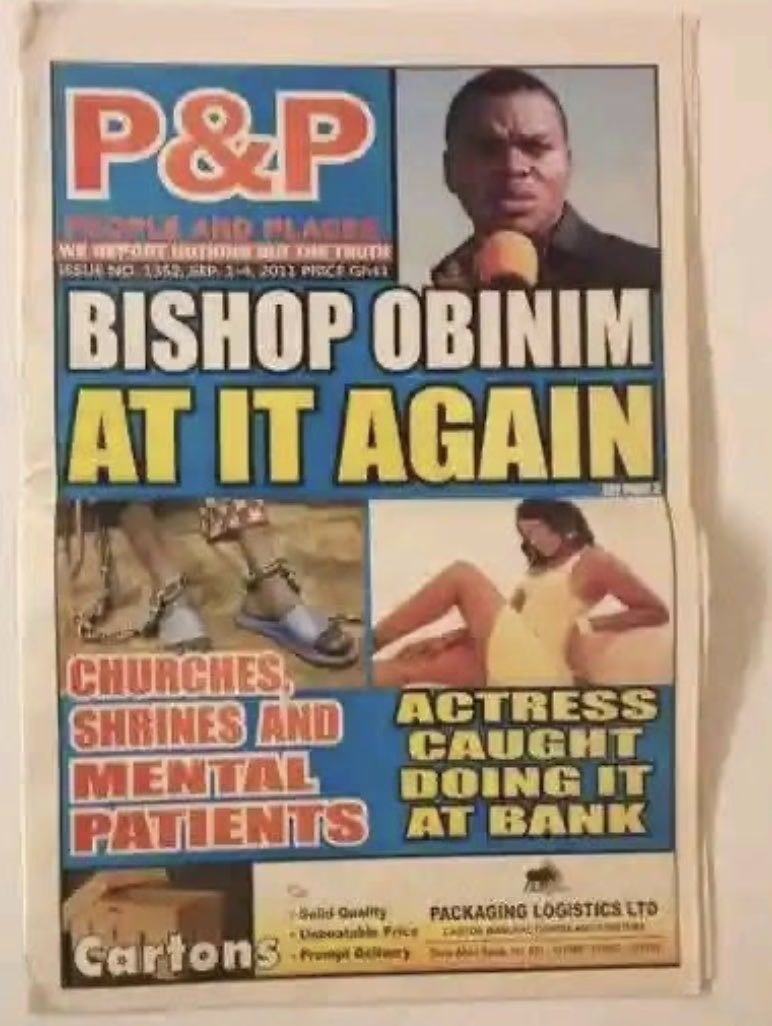
In the golden days of Ghana’s print media, one publication stood out not for its formality, but for its ability to capture attention and dominate conversations on the streets—P & P Newspaper.
Officially known as People and Places, the paper earned legendary status in the 1990s and early 2000s, becoming a must-read for many Ghanaians who craved stories that felt real, dramatic, and deeply relatable.
P & P was not your typical newspaper. While mainstream publications focused on politics, business, and official reports, P & P went in a completely different direction.
It told the stories of the streets—the kind of stories people whispered about, argued over, and couldn’t ignore.
From mysterious happenings and unusual events to intense relationship drama and shocking life experiences, the paper had a way of turning everyday situations into gripping narratives.
One of its most powerful tools was its headline style. The front page alone could stop you in your tracks.
Bold fonts, dramatic wording, and emotionally charged language made it impossible to walk past without taking a second look. For many, that glance was enough to convince them to buy a copy.

In fact, reading P & P often felt less like consuming news and more like watching a movie unfold page by page.
The paper’s strength lay in its connection to ordinary people. It focused on human interest stories that reflected the realities of life in Ghanaian communities—stories from the ghettos, marketplaces, towns, and neighborhoods.
It spoke directly to the experiences of the average person, making it highly relatable and widely discussed.
Whether it was love gone wrong, unexplained events, or personal struggles, P & P brought these narratives to the forefront in a way that no other paper did at the time.
Of course, its sensational approach did not come without criticism. Some questioned the accuracy of certain reports, arguing that the desire to attract attention sometimes overshadowed strict journalistic standards.
Yet, despite these concerns, the paper’s popularity never faded during its peak. People kept buying, reading, and talking about it because it delivered something unique—emotion, suspense, and connection.
P & P also played a significant role in shaping Ghana’s media landscape. It proved that storytelling could be just as powerful as traditional reporting.
It influenced how news could be packaged and presented, blending information with entertainment in a way that resonated with a broad audience.
Today, in an era dominated by digital media and instant news updates, the memory of P & P Newspaper remains a nostalgic reminder of a time when print ruled the streets.
It represents a period when a single headline could spark nationwide conversation and when newspapers were an essential part of daily life.
Wolley Writes reminds us that if these stories are not told, a whole generation may never understand the impact such platforms had.
P & P was more than just a newspaper—it was a cultural phenomenon, a storyteller of the streets, and a symbol of a unique era in Ghana’s history.