

|
Getting your Trinity Audio player ready...
|
The streets of Accra once echoed with a name that inspired fear, tension, and uncertainty—Ataa Ayi.
For many Ghanaians who lived through the late 1990s and early 2000s, his name was not just a rumor or urban legend; it was a reality that shaped how people moved, handled money, and even trusted their surroundings.
At the height of his notoriety,
became widely known as Ghana’s most feared armed robber, a man whose operations were bold, calculated, and shockingly public.
Born Raymond Ayi Ayite in 1973 at Adabraka, Accra, Ataa Ayi’s early life was far from the criminal image he later embodied.
He grew up like many children in the capital, facing the everyday struggles of a developing city.
He attended Radiant Way Preparatory School in Odorkor, but his education was cut short at a young age.
His mother’s relocation to the United Kingdom significantly affected his upbringing, leaving a gap in guidance and stability during his formative years.
Without proper supervision, he gradually drifted into street life, where survival instincts often replaced long-term aspirations. Like many young men in similar circumstances, he sought a trade and eventually trained as a mechanic.
This skill opened doors for him, allowing him to learn how to drive—an ability that would later play a critical role in his criminal career.
He soon became a taxi driver, trying to make ends meet in a competitive and often unforgiving environment.
However, life took a drastic turn in 1998 when he was involved in a car accident while working.
The vehicle he drove was not his own, and the damage left him heavily indebted to the car owner.
Suddenly, his only source of income was gone, and he found himself in a difficult financial position. It was during this vulnerable period that he was introduced to a man named Eddie, who offered him what seemed like a lifeline.
Initially, Ataa Ayi believed he was being hired as a personal driver. But it did not take long for him to realize that the job involved criminal activities.
Eddie and his associates were engaged in stealing cars and valuables from unsuspecting victims.
At first, Ataa Ayi was hesitant. The risks were obvious, and the path was dangerous. However, desperation can push people into decisions they might otherwise avoid. Eventually, he agreed to participate.
His role began as a getaway driver. With his strong driving skills, he became responsible for ensuring quick and smooth escapes after operations.
This role kept him slightly removed from direct confrontation in the early stages, but it also allowed him to observe and learn.
Over time, he became more involved, gaining the trust of his associates and eventually transitioning into a central figure within the group.
What made Ataa Ayi particularly notorious was his gang’s method of operation. Unlike many criminals who preferred the cover of darkness, Ataa Ayi and his team carried out robberies in broad daylight.
This bold approach shocked the public and increased the level of fear associated with his name. Their primary targets were individuals who had just withdrawn large sums of money from banks.
With the help of informants positioned around financial institutions, the gang tracked potential victims and struck at carefully chosen moments.
Their operations were swift and highly coordinated. Victims were followed discreetly, and once they reached a less secure location, the gang would strike. Armed with weapons, they would quickly overpower their targets and seize cash and valuables before disappearing within minutes.
This efficiency made it difficult for authorities to respond in time, allowing the gang to operate repeatedly with apparent success.
Over the years, Ataa Ayi reportedly participated in or masterminded approximately 38 robberies. These included high-profile incidents involving significant sums of money in both local and foreign currencies.
In addition to cash robberies, the gang was also involved in stealing vehicles, which were often sold across borders through underground networks.
Despite his fearsome reputation, there has been ongoing debate about the extent of violence directly attributed to Ataa Ayi.
While he was widely regarded as dangerous and heavily armed, some accounts suggest that there is no clearly documented case proving he personally killed anyone.
This has led to differing opinions about his legacy, with some viewing him as a ruthless criminal and others questioning whether parts of his story have been exaggerated over time.
Nonetheless, there is no doubt that his activities created widespread fear and disrupted normal life for many residents, particularly in Accra. His name became synonymous with danger, and his presence—real or rumored—was enough to cause panic.
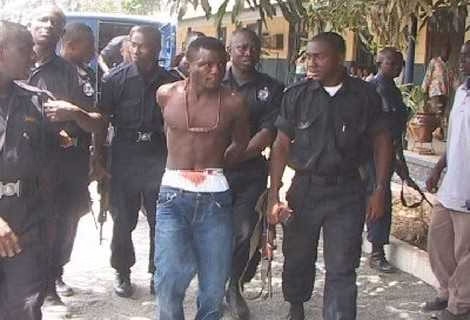
After years of evading law enforcement, Ataa Ayi’s reign came to an unexpected end on February 28, 2005. In a twist that few could have predicted, his arrest was not the result of a major police operation targeting armed robbery.
Instead, it stemmed from a domestic incident at his sister’s residence in Nungua.
According to accounts, a misunderstanding led to an assault complaint involving a family member.
Police officers were called to the scene to address the issue. At the time, they were unaware that they were dealing with one of the country’s most wanted criminals.
During their interaction with him, however, they began to suspect his identity. Further questioning confirmed their suspicions, leading to his arrest.
Before his capture, authorities had gone to great lengths to locate him. His image had been displayed on billboards across several regions of Ghana, a rare move that highlighted the seriousness of his case.

For years, he had managed to stay ahead of law enforcement, making his eventual arrest all the more surprising.
His capture marked the end of a significant chapter in Ghana’s crime history. For many citizens, it brought a sense of relief and closure after years of fear and uncertainty.
It also served as a reminder that even the most elusive criminals can eventually be brought to justice.
The story of Ataa Ayi is not just about crime—it is a reflection of how circumstances, environment, and personal choices can shape a person’s life.
From a young boy in Adabraka to a mechanic, a taxi driver, and eventually one of Ghana’s most feared armed robbers, his journey is both tragic and cautionary.
Today, his name continues to spark conversations across Ghana. Some remember him for the fear he created, while others see his story as a lesson about the consequences of desperation and poor decisions.
Regardless of perspective, Ataa Ayi remains one of the most talked-about figures in Ghana’s true crime history.